East Coast
A distinct East Coast language.
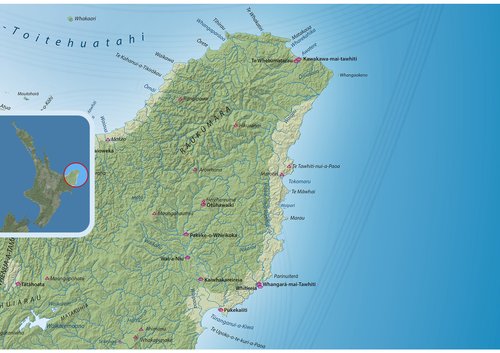
Hero image: Te Tai Rāwhiti from Te Ika-a-Māui map [screenshot]. Retrieved from the Toitū Te Whenua Land Information New Zealand website, in 2025.
Marae protocol and suppression of the Māori language are topics of discussion here.
When you are asked ‘how are you?’, you know you have arrived in the Ngāti Porou region. The following taonga include examples of the way that ‘ahau’ is pronounced. Words like ‘kōkā’ are heard. Listen to the unique flow of te reo Māori by these elders of Ngāti Porou.
Macrons are also not used throughout this area as it’s argued that vowel length can be learnt through oral language.
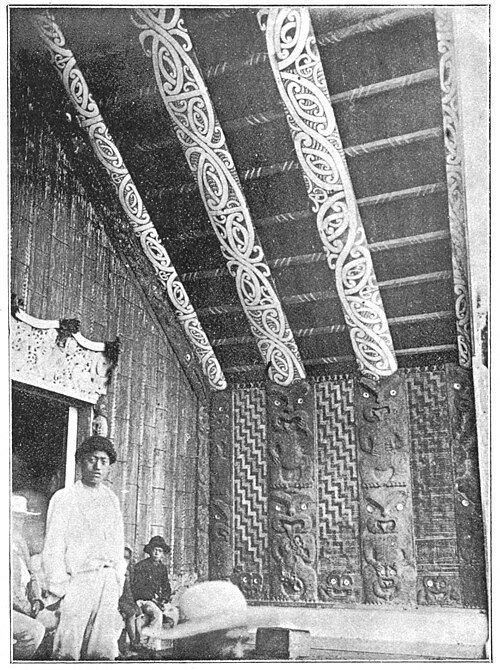
Source: Part of the Verandah, or Porch, of the large House of the Ngati-Porou, at Wai-o-Matatini, East Cape, New Zealand. Augustus Hamilton, 1896.
Iwi: Ngāti Porou
A woman of great prestige and reputation, Whaia McClutchie pushed the boundaries in her time. Whether in the front or back of her marae, the voice of Whaia would demand attention.
Whaia expresses her thoughts on women speaking on the marae and the reason for her fearlessness in the face of many challenges presented to her. She describes the origins of the right of women to speak on the marae in her area.
Thoughts and hopes for the younger generation of Ngāti Porou. While the people are exploring all corners of the world – travelling overseas and exploring new experiences – they can continue to maintain the kaupapa while the taonga wait for them at home.
Whaia greets the host, the purpose of their discussion, and gives thanks and praise.
● tunu / tonu / quick pronunciation of “still”
● kua whakatāne i au / I take a man’s role
● wāhanga hoki / quick pronunciation of “this section”
● taitama / man
● mārama kaitā / understand well
● porowhiu / throw
● he mea aroha rā / it’s awesome…
● te wā hou / modern times
● ko te pīrangi rā kē atu / what is really needed
● tēnei wā iho / this time
● kei runga i te hau e haere ana / being broadcast
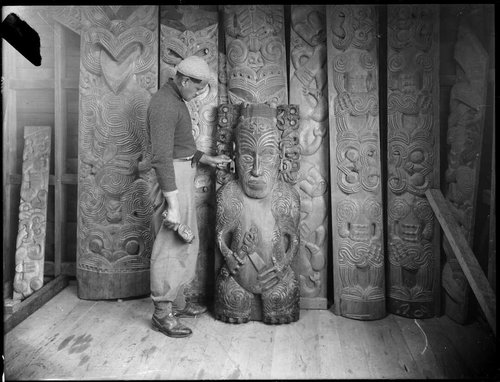
Pine Taiapa and Maori wood carvings. Ref: 1/1-003883-G. Alexander Turnbull Library, Wellington, New Zealand. /records/23203059
Iwi: Ngāti Porou
Hapū: Te Whānau-a-Hinerupe, Te Whānau-a-Te Aotaihi, Te Whānau-a-Umuariki
Pine Taiapa was a man of many talents. A Māori All Black, farmer, teacher, and writer, to name a few. However, he was mostly renowned as one of the few master carvers of his time, leading the revival of this precious art throughout Aotearoa.
Growing up with ancestral knowledge passed down through generations, he also received an education at Te Aute College, willingly sharing his knowledge with those fortunate enough to be under his instruction.
Pine discusses unique aspects of protocol within Ngāti Porou when visitors go on to the marae. Where women and men sit, on which side of the house, the way that manuhiri are brought onto the marae, and how they enter the whare.
Pine discusses the nature and sequence of speakers during welcoming ceremonies in the boundaries of Ngāti Porou and the skills needed to be given the authority to speak. Speakers should have knowledge of the area and of those who have recently passed.
The significance and authority of women orators on marae within the boundaries of Ngāti Porou. This tikanga originates from well-known women ancestors such as Hinematioro, and the tradition was then passed down to her descendants. The tradition traces back to Hawaiki and Pine discusses how it is maintained today.
● te riu i Waiapu / the Waiapu valley
● e anga ana / facing
● ko waenganui tēnei / this is central
● mā te tangata mārika / for the correct person (to do)
● me tae noa iho katoa / should just arrive
● kāre e tū ana / doesn’t stand / isn’t standing
● taina / younger brother or sister
● pōhiri / welcome
● manuhiri / visitor
● he ahakoa / although
● te tangata māna e wāhi ngā kōrero / the person who begins the speeches
● ngā pakitara ā-whare / the walls
● e āpititia ana / being added to
● kei te tirohia atu e ia / he is looking at
● ki te kore e kitea ngā tāne / if there are no men
● engari kāo / but no
● hei whakamaru au / I will be a shelter
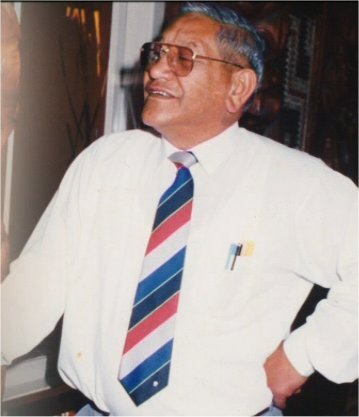
Image of Boy Rokopa Te Iwi Kohuru Mangu. Courtesy of Te Wānanga o Aotearoa.
Iwi: Ngāti Porou
Boy Mangu lived for many years in the Waikato region, in Te Awamutu. He was a Māori language teacher at Te Awamutu College which led to him building relationships with local hapū and whānau, extending all the way over to the Puniu river.
Boy played an important role during the establishment of Te Wānanga o Aotearoa in Te Awamutu in the 1980s, joining the board. He is remembered for his role to empower mātauranga Māori in the area.
This was the first day of Te Wiki o te Reo Māori in 1981. Boy stood to greet the visitors and the purpose of the hui, following the format of mihi used in the local area of Ngāti Porou. The recording has excellent examples of mihimihi and kōrero expressed by the young and the old.
On his first day of school as a child, Boy wasn’t allowed to speak Māori. Boy outlines some of the events that occurred that day.
Through compelling storytelling, he recounts how his generation lost their reo and how his teacher punished him for speaking his language.
● e noho mai rā / occupying
● ngā momo here / the types of connections
● te ao hurihuri / the changing world
● hei ope whakatuwhera / a group to launch
● ākuanei rā koe te rongo ai / soon you will hear
● kua mihi, kua tangihia, kua ea / have been greeted and grieved for, this is complete
● tātou te whatu ora / us as the living
● pango / black
● kia kōrero au i tētahi kōrero / let me tell a story
● i taua rā tuatahi nei / on the first day
● ka āwangawanga aku whakaaro / I was worried
● konohi / face
● pona / knee
● i auwa nei / for me