King Country
The Ngāti Maniapoto region.
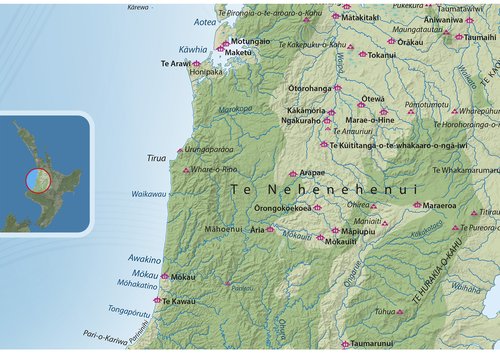
Hero image: Te Nehenehenui from Te Ika-a-Māui map, the Land and its People [screenshot]. Retrieved from the Toitū Te Whenua Land Information New Zealand website, in 2025.
'Stick to that, the straight-flying cormorant'
Within the Tainui waka region, the Māori language carries distinctive local features that reflect ancestral connections and regional identity. These subtle variations – in pronunciation and vocabulary – are markers of whakapapa.
Some notable features are the use of ‘ngia’ as a passive ending, a grammatical form that distinguishes the Tainui dialect from others. The ‘wh’ sound in words like ‘manuwhiri’ and ‘pōwhiri’, the ‘e’ in ‘tētehi’ and ‘ētehi,’ the 'u’ in ‘tūpuna’ instead of ‘tīpuna’, and other unique local words such as ‘matara.’
Here is a taonga that highlights many of these language features.
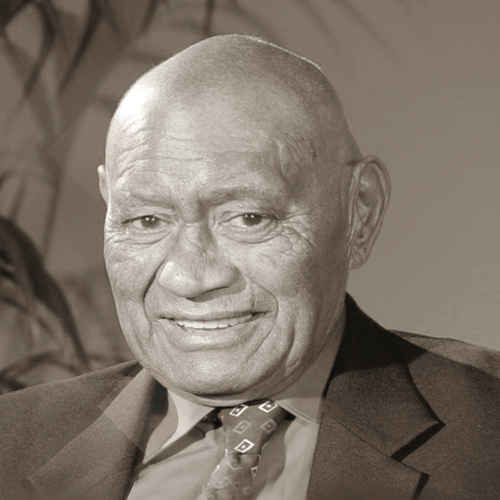
Tui Adams when he was on the board of Te Wānanga o Aotearoa. Image courtesy of Te Wānanga o Aotearoa.
Iwi: Ngāti Maniapoto, Ngāti Rungaterangi, Ngāti Matakore, Ngāti Raukawa
Tui was a hands-on worker in his youth and adulthood. Upon reaching elderly status he was a leader and advocate for the Kiingitanga movement and his iwi. Extremely generous, he freely shared his knowledge and expertise with the people.
In recognition of his contributions, he received an honorary doctorate from Waikato University and was awarded the Queen’s Service Medal (QSM).
Tui talks about his upbringing, his iwi, and significant landmarks that define his sense of belonging. He describes life on a farm, away from town – a different world where Māori whānau lived together in villages throughout King Country, and where te reo Māori is still spoken by whānau.
As a child, his kuia cared for the kids while his dad worked as a builder and farmer.
On weekends, the family would travel into town to play sports.
It was there that he met his first wife, and together they went on to have children.
With a large family at home, Tui and his younger brother began working as soon as they left school. He discusses the types of roles they took on over the years, leading up to the time he moved to Horotiu and Kirikiriroa for work.
Listen to the entire taonga here
Collection Reference: A248043
Year: 2015
Credit: Raukawa FM; Adam, Tui
● Consistent use of the passive form through the interview
● i tiwhiketetia rā / I was certificated
● ka waipuke nuitia / a large flood
● ka ingoatia au / I was named
● tētehi / a (singular)
● whēnei, whēnā / like this, like that
● Te Nehenehenui / King Country
● taimahatanga / pressures
● …tokoiwa pea aku tau / perhaps when I was nine
● kirīmi / cream
● kēna / can
● he pika, he hāpara / pick and shovel
● raima / lime (concrete)
● purei pāoro / play rugby
● tereina / train
● wheketere / factory