Early Queer Organising Through To Law Reform
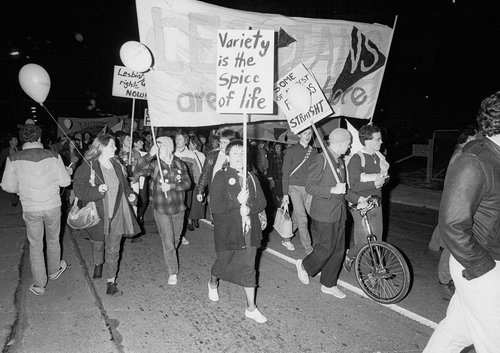
Hero image: March in support of homosexual law reform, 24 May 1985, by a Dominion Post photographer. Ref: Dom/1985/0524/1/23A-F Alexander Turnbull Library.
Note: Given their age, some of these recordings contain outdated language, homophobic attitudes, and/or inaccurate information. The images and commentary within collection items reflect the times in which they were made, and some audiences may find them confronting.
The first formal organization for homosexual men in Aotearoa New Zealand was the Dorian Society. It was established in 1962 in Wellington as a social club for gay men, intended to be a safe haven for free expression out of the public eye. Discretion was important because sex between men was still illegal, and the penalties could be harsh.
In 1963 members of the Dorian Society began exploring how to lobby for law reform, which ultimately resulted in the formation of the NZHLRS in April 1967. The aim of the group was to promote the decriminalization of homosexual acts between consenting adults in private settings.
In 1968 the Reform Society presented a petition to Parliament urging legal changes. The below film shows interviews with politicians after the petition was rejected.
This interview with Dr. Ira Pauly from 1970 shows the scientific approach to homosexuality that this law reform movement was hoping to shift. Dr Ira Pauly is asked to clarify whether homosexuals are considered mentally ill based on their sexual preference.
Dr. Pauly discusses “aversion deconditioning” “treatments” for homosexuals. It was a commonly held view among medical practitioners in the early 1970s that homosexuality was “an illness to correct”.
Beyond this New Zealand interview, Dr. Pauly had dedicated much of his psychiatry career to advocating for transgender individuals and their access to medical procedures. This was a revolutionary stance to take at the time.
The gay liberation movement was given a jump-start in Auckland in 1972 when Ngāhuia Te Awekōtuku (Te Arawa, Tūhoe, Waikato) was denied a US visa on the grounds of being a lesbian, an injustice which she used to successfully mobilise the creation of the Auckland Gay Liberation Front.
Ngāhuia was already an outspoken member of the women’s movement, advocating for Māori women and sapphic identities within the movement. In 1971, she mentioned lesbianism within the women’s movement in a televised interview during a women’s march.
This is further discussed in the below documentary from 1985, where Ngāhuia reflects on the connection of lesbianism and the women’s movement.
This programme from April 1972 shows the Gay Liberation Front in Auckland advocating for their cause. Ngāhuia Te Awekōtuku can be spotted in some of the interviews. The group members discuss the oppression they face on a daily basis, and the ways their lives are affected by the law.
In the opening conversation the interviewer asks the group; “Most people would consider you all deviants. Are you ashamed of what you are?” She is met with laughter.
Student activism in Auckland was a large driver of media attention to the topic of Homosexual Law Reform. At this time, student activists in the Gay Liberation Front were raising awareness that homosexuality was not harmful - but a sexist society was. Like the NZHLRS they called for legal change, but as only one aspect of a greater social and sexual revolution. This happened simultaneously with the legal changes being sought by the Homosexual Law Reform Society.
This below title shows interviews with Auckland students, a public demonstration, and interviews with the Gay Liberation Front, broadcast July 1973.
This current affairs story is from June 1974, just prior to the second annual Gay Pride Week in New Zealand. It shows the mobilisation of the queer community outside of the major cities, and members of the Gay Liberation Front talk about the necessity of being outspoken.
In 1974 National MP Venn Young introduced a Crimes Amendment Bill to legalise homosexual acts by those aged 21 and over, however it did not pass the second reading. The community response to this bill was divided between those with a liberal approach and those with a radical approach. Some argued that the bill was not enough of a change, as the age of consent would not match the heterosexual age of consent (being 16), therefore maintaining inequality.
It is important to note that there were significant internal divisions amongst the gay liberation movement at this time. Groups such as gender minorities, women and Māori would often feel excluded. This 2022 Spinoff article speaks to these divisions in greater detail.
This title from July 1974 shows a member of the Homosexual Law Reform Society speaking about the lack of support from government, despite having the bill raised in the first place.
Following the defeat of Young’s bill, the gay liberation movement was in a fractured state. Many searched for ways to revive a dwindling movement. For some activists, the answer lay in greater co-ordination at the national level; and so the movement’s first national activist organisation, the National Gay Rights Coalition, came to fruition in 1977.
The National Gay Rights Coalition aimed to repeal oppressive laws, battle social stigma, and ensure that sexual orientation was protected from discrimination under the Human Rights Commission Act. By 1979 the Coalition had grown to 32 member groups and over 70,000 affiliated supporters.
The below report from 1979 focuses on the Defence Department’s announcement that individuals found guilty of homosexual conduct would be discharged. The secretary of the Gay Rights Coalition speaks about the implications of this decision.
This Eyewitness episode from 1980 dives into the recent movements of the homosexual community. It covers several key occurrences of the year, including an interview with Ian Scott, Labour candidate for Mt. Eden. Ian was the Labour Party’s first openly gay candidate; however he was not successful.
The episode covers the proposed amendment to the Crimes Act (1961), suggested by Warren Freer, to legalise homosexuality with the age of consent being 20. The Gay Rights Coalition refuted this proposal, given that it was not equal to the heterosexual age of consent. It also discusses the first New Zealand feature film featuring homosexuality, Squeeze, directed by Richard Turner.
Reform would come to fruition with MP Fran Wilde’s Homosexual Law Reform Bill, introduced in 1985 and passed into law in 1986. Her Bill garnered a huge response from the public, on both sides of the argument. The below episode of Kiwifruit delves into the lead-up to the Bill passing. It was made as a 20th anniversary special in 2006 and features retrospective interviews with key figures and news coverage from the time.
To view more media coverage from the lead-up to the Homosexual Law Reform Bill passing, please see this Ngā Taonga-made compilation of archive material: