Voices of J Force: Recordings of New Zealanders in post-war Japan
11 Aug 2025
To commemorate the 80th anniversary of VJ Day, Ngā Taonga shares 200 historical audio recordings of New Zealanders serving in J-Force from 1946 – 1948.
By Sarah Johnston, sound history researcher
Some of the audio recordings in this collection contain language or sentiments that may be considered offensive or inappropriate, and reflect the time in which they were taken.
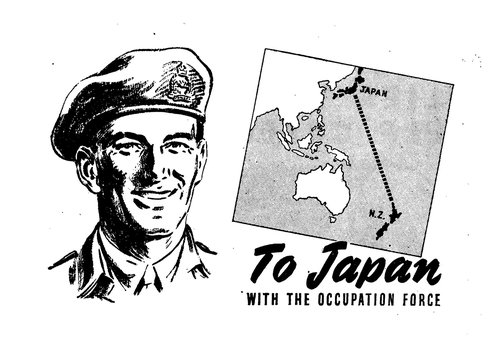
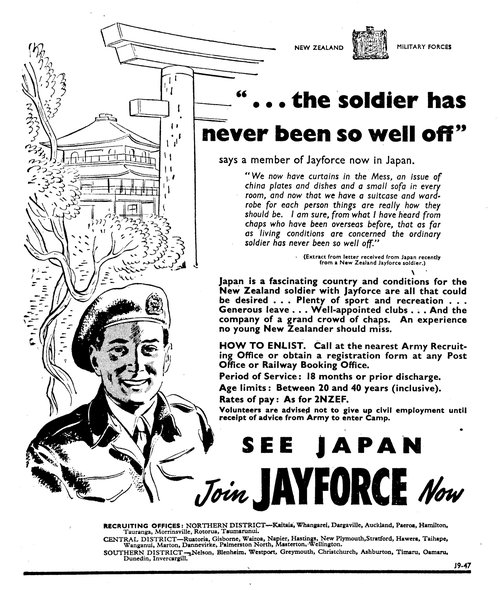
Hero images: J Force recruitment advertising, New Zealand Listener magazine, 29/03/1946 and 14/03/1947. Courtesy of Papers Past.
For the 80th anniversary of VJ (Victory over Japan) Day, and the official end of World War 2 Ngā Taonga have been working with Sound History Researcher Sarah Johnston to upload approximately 200 audio items relating to the post-war occupation J Force. This force involved some 12,000 New Zealanders, including a separate unit of Māori troops. Ka rongo koe i ngā reo o rātou kua ngaro ki te pō. E tangi ana, e mihi ana. We also share Sarah's blog 'Voices of J Force', providing us with important insights into the experiences and observations of the New Zealand troops and their daily interactions with the local Japanese people.
August 6 marks the 80th anniversary of the dropping of the atomic bomb on Hiroshima, Japan, the first use of atomic weapons. It was followed by a second bomb on the city of Nagasaki on August 9 and on August 15, 1945, Japan surrendered to the Allied forces, marking the end of World War II. This was celebrated in Allied nations as VJ Day and marked around New Zealand with parades and church services.
With the war over, a new relationship with Japan was now required. The United States took over military government of the country while a British Commonwealth Occupation Force, or BCOF, was set up to de-militarise Japan. Around 12,000 New Zealanders served in BCOF between 1946-1948, alongside Australian, British and Indian troops, largely in the south and west of the country. The New Zealanders were referred to most commonly as Jayforce (or J Force).
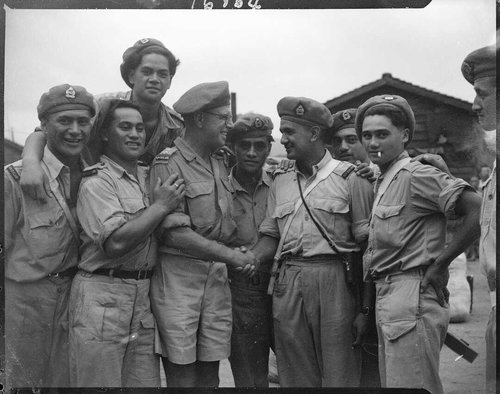
Ref: J-1485-F. Alexander Turnbull Library
Māori soldiers of 2 New Zealand Battalion and Senior Chaplain Padre Harry Taylor, at Ozuki, Japan, 1948.
The men of J Force
The first New Zealanders arrived in Japan from Italy in March 1946. This party included men from the reinforcements of 28 Māori Battalion, who had been at sea on their way to Italy from Aotearoa when the war in Europe ended in May 1945. While some men in the draft from Italy were conscripts, the Māori were all volunteers.
Further volunteers came directly from New Zealand attracted by advertisements like the one above. Service in J Force offered young men an opportunity to serve in a country very few New Zealanders had ever visited – and now, without the dangers of facing active combat. A Royal New Zealand Air Force Squadron and a party of New Zealand Army nurses were also recruited, again from volunteers.
Once in Japan, a Māori unit was established, this time as D Squadron of the New Zealand Divisional Cavalry, with platoons formed along tribal lines similar to the way men were organised in the 28 Battalion. Like most J Force units, they were based in Yamaguchi Prefecture, not far from the atomic bomb-devastated city of Hiroshima. The New Zealanders oversaw demilitarisation of the rural area, rounding up and destroying weapons and military equipment. They were involved in organising the repatriation of Japanese soldiers and ex prisoners-of-war who were returning home from the Pacific and Southeast Asia. They oversaw elections and worked to stem illegal immigration to Japan from Korea.
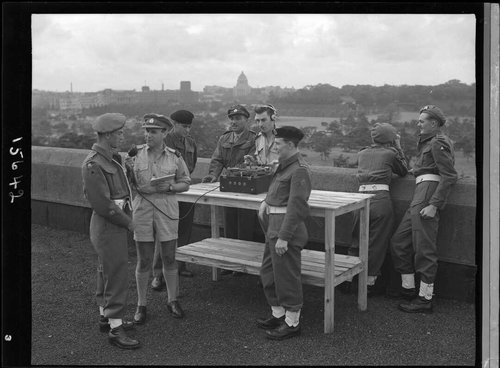
Ref. J-0541-F, Alexander Turnbull Library
Warrant Officer Stuart Nicholls of the New Zealand Guard Battalion records for the National Broadcasting Service in Tokyo, October 1946.
With the Kiwis in Japan
The New Zealand National Broadcasting Service sent a two-man recording unit to Japan in June 1946. It was no doubt hoping to replicate the success of its wartime mobile units which had travelled with New Zealand’s fighting forces in North Africa, Italy and through the Pacific from 1940 to1945. These units recorded messages home from service personnel onto lacquer discs, which were sent back, edited and compiled into a very popular weekly radio show. With the Boys Overseas aired nationwide on Sunday nights. The discs are now cared for by Ngā Taonga Sound & Vision, and I use them in my research.
The J Force version of this programme was called With the Kiwis in Japan and was initially produced and hosted by Ulric Williams, a banker-turned-radio-announcer from Napier, who also had a background in music and theatre production. As there would be no military action in Japan for him to report on (this had made up a large part of the wartime mobile broadcasting units’ work), it was hoped the broadcasters would help the New Zealand men set up bands and put on concerts and other entertainments for fellow troops. Williams later went on tour in Japan with the Kiwi Concert Party and was replaced as host by Palmerston North radio announcer Doug Smith.
The other member of the J Force broadcasting unit was technician and engineer Linden Martin, who had worked at station 2YH Napier before joining the Army during the war. Both he and Williams can be seen at work in this photograph above, taken on the roof of Empire House, Tokyo in October 1946. This was the headquarters of BCOF and a useful vantage point overlooking the Imperial Palace, where they watched New Zealand troops take over duty as the Tokyo Guard Battalion. This was a body of men which stood guard outside the Imperial Palace, the British Embassy and other key buildings in the occupied Japanese capital.
The Guard Battalion
In one of the earliest recordings on the surviving J Force discs held in the RNZ Sound Archives collection at Ngā Taonga Sound & Vision, Ulric Williams describes the guard-change ceremony and interviews two officers who took part. In the photo above, Williams holds the microphone up to Stuart Nicholls of Christchurch (far left) who was the Regimental Sergeant-Major in charge of the Guard Battalion. Linden Martin wearing headphones, is operating the disc recorder. The Māori officer on his right is most likely Lieutenant Te Wananga Haig (Ngāti Porou) who provided radio commentary in te reo Māori about his D Squadron men who had been chosen to be part of the Guard Battalion.
Following the commentary of the guard changeover, the broadcasting unit recorded greetings from several of the men taking part, who tell their listening families what they have been up to while in Tokyo: shopping for cameras, sight-seeing, visiting an American forces theatre and going for a rickshaw ride. The Guard Battalion greetings (which can be heard here) include two messages to whānau in te reo Māori, from Guard commander Lieutenant Charles Tarei Taite (Ngāti Tūwharetoa) and Ted Erihe Emery of Kaeo, in Te Tai Tokerau. Ted Emery also sends multiple greetings to whānau Māori on behalf of other men who were not lucky enough to be chosen to make a recording themselves*
Ref.J-0012-F Alexander Turnbull Library, Wellington
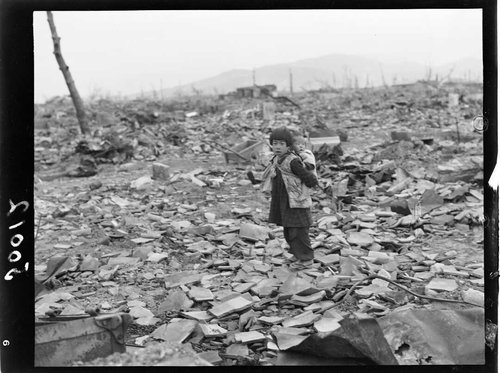
Hiroshima - Small child with baby on back searching for anything of usefulness.
Life in postwar Japan
Apart from the greetings recordings and commentary on military events like the Tokyo Guard ceremony, many of the J Force Broadcasting Unit recordings in this collection seem to be an attempt to explain Japan and its people to a New Zealand radio audience. In 1946, Japan was a country few New Zealanders had visited and most knew very little about, except that up until a few months previously, it had been a feared enemy. This wartime mind-set may explain some soldiers’ comments in the recordings which today seem like casual racism towards the Japanese people. However, a recording like this interview with Lieutenant Jim Godwin of Blenheim who spent 15 months enduring horrific conditions in Japanese prisoner of war camps, provides some insight into what lay behind feeling towards Japan at the time.
Yet in other recordings there is an appreciation by some of the J Force men for the hard lives of ordinary Japanese civilians, for whom the war had brought devastation, famine and poverty.
In rural Yamaguchi where the New Zealanders lived and worked, many Japanese people were still living a subsistence agricultural lifestyle. Food was so scarce that the occupation forces were forbidden from buying food in Japanese stores and most of the military’s rations were imported. This led to a thriving black market with occupation troops exchanging rations for Japanese souvenirs such as silks, pearls and craft items to send home.
Most of J Force experienced Hiroshima as it lay between their arrival port at Kure, and Yamaguchi where they were based. Visiting the atomic bomb-damaged city was also something of a tourist attraction for soldiers on leave and concern about lingering radiation was apparently not an issue. In this recording, three New Zealanders, John Macnab, Larry Zampese and Johnny Overend, are interviewed about a recent visit to Hiroshima in late 1946. They matter-of-factly discuss the incredible damage caused 15 months earlier by just one bomb. (Fifty years later in 1995, one of the three, Dr John Macnab was interviewed again, this time by RNZ’s Jim Sullivan and he looked back on the morality of dropping the atomic bomb on Japanese civilians and whether it was justified in shortening the war).
A New Zealand hospital was set up at Kiwa and there are several recordings of J Force nurses in the collection. In this one, Sergeant Joyce Ford of South Canterbury talks about what she has observed of the lives of Japanese women who were employed in the hospital as housekeepers. She remarks on the hard physical labour expected of rural women, but remarks that already modernisation is taking place. The occupation of Japan by the United States and British Commonwealth forces aimed to democratise the country, and the introduction of female suffrage was one of the early reforms it introduced.
RNZ collection, Ngā Taonga Sound & Vision
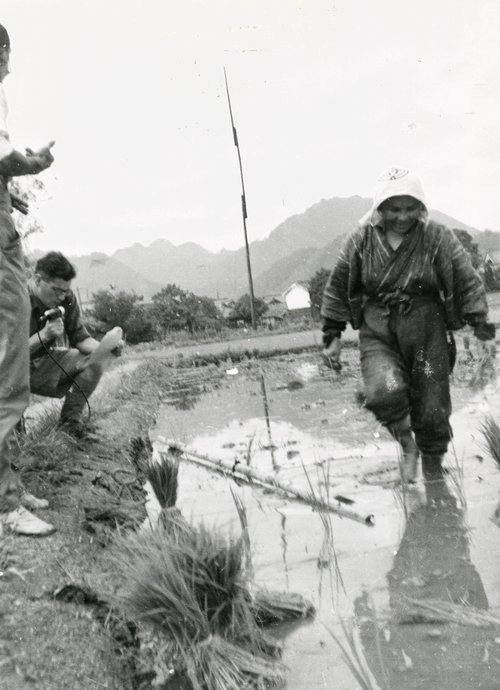
Doug Smith recording a programme about rice planting, in a paddy field near Yamaguchi, Japan, in 1947.
Eighty years after these recordings were made, Japan is now a leading democratic and economic power, and one of the world’s most popular tourist destinations. The charms of Japanese onsen or hot springs, ski fields and traditional cultural practices such as the tea ceremony were also experienced by the New Zealanders of J Force and reported to New Zealand radio audiences in recordings by the broadcasting unit. In these, we occasionally hear voices of the Japanese people themselves, such as Mr Nakamura-san of Yuda and his daughter Ikoku-san, who serve the tea ceremony, and in short interviews about aspects of Japan with an English-speaking young woman interpreter, Yunko-san.
My current research work on the J Force recordings will continue for several more months. I am verifying the identity of all the speakers in the recordings and enhancing the existing descriptions of the recordings in the Ngā Taonga Sound & Vision online catalogue. The digitised recordings will also be uploaded enabling descendants and researchers to listen to them and learn more about J Force and those who served in it.