Soon May the Wellerman Come
5 Aug 2025
A 1969 NZBC recording in the Ngā Taonga collection casts new light on the history of a New Zealand song that became a TikTok sensation.
By Dr Michael Brown. Curator (Music), National Library of New Zealand Te Puna Mātauranga o Aotearoa.
Among the unexpected events of the COVID-19 lockdown years was the sudden online popularity of a New Zealand whaling song, “Soon May the Wellerman Come”.
It began on December 28, 2020, when Scottish postman and sea shanty enthusiast Nathan Evans posted a video of himself singing “Wellerman” on social media platform TikTok.[i] Others began layering harmonies and accompaniments on Evans’ original video using TikTok’s 'duet' function, creating numerous alternative renditions. Within only a few weeks the video had been viewed over 4 million times. This viral phenomenon received global media attention, often being regarded as a spontaneous communal release after months of pandemic-imposed isolation.
‘Nathan Evans Wellerman Family Tree — shantytok mashup/supercut’. YouTube.
Evans subsequently released the song as a single and dance remix, topping the charts in many countries. Each version has now been streamed almost half a billion times on Spotify, with similar numbers on other platforms.
All this for a New Zealand folk song. The plot thickens though, as “Soon May the Wellerman Come” is wrapped in intriguing layers of history, mystery, and controversy. It is unclear where it originally came from or when it was composed. Now, a little fresh light can now be cast on such matters due to the rediscovery of a 1969 recording of “Wellerman” – the earliest known version – in the Ngā Taonga Sound & Vision collection.
“Soon May the Wellerman Come” performed by Neil Colquhoun (vocals, guitar), Robbie Laven (tin whistle), and Kerry Dye (bass). Excerpt from ‘The New Settlers’, Episode 2 of the 1969 ‘Songs of a Young Country’ radio series (ref: 22859).
But before outlining the story of this recording, what is the song about? “Soon May the Wellerman Come” is a tall tale about the Billy of Tea, a fictional whaling ship that puts to sea, encountering and harpooning a right whale. Resisting capture, the whale takes charge and tows the ship across the high seas, seemingly forever. As the song concludes:
As far as I’ve heard the fight’s still on.
The line’s not cut and the whale’s not gone.
The Wellerman makes his regular call
To encourage the captain, crew and all.[ii]
The “Wellerman” refers to the English-born Weller brothers – Joseph (1802-1835), George (1805-1875), and Edward (1814-1893) – who established various whaling and trading enterprises in Sydney in 1829, then expanded their operations to Aotearoa New Zealand in 1831. Their shore whaling station at Ōtākou on the Otago Peninsular became a thriving settlement in the 1830s, local members of Ngāi Tahu being heavily involved.[iii] The Wellers also ran a ship supply business, as referenced in the song. “Soon may the Wellerman come,” the chorus goes, “To bring us sugar and tea and rum!”
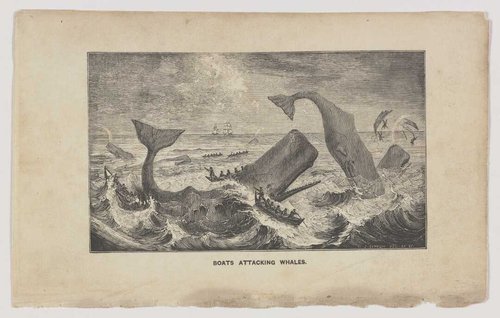
William James Linton (1812-1898). Engraving of boats attacking whales (1830s). Ref: A-109-046. Alexander Turnbull Library, Wellington, New Zealand. /records/22859435
“Soon May the Wellerman Come” came to light through the efforts of Neil Colquhoun (1929-2014), a music educator and folksong enthusiast. Colquhoun began collecting, arranging, and writing New Zealand folk songs in the 1950s, performing them with his group The Song Spinners. Until now, general understanding has been that “Wellerman” was first brought to public attention in the early 1970s with Song of a Young Country, a title used both for a New Zealand folksong anthology and double album, both overseen by Colquhoun. The LP was released in December 1971 and included “Wellerman” performed by Tommy Wood; the anthology followed in June 1972 and featured sheet music for the song. The two versions have somewhat different melodies, with Colquhoun’s minor-key printed version being closer to later renditions such as Nathan Evans’.
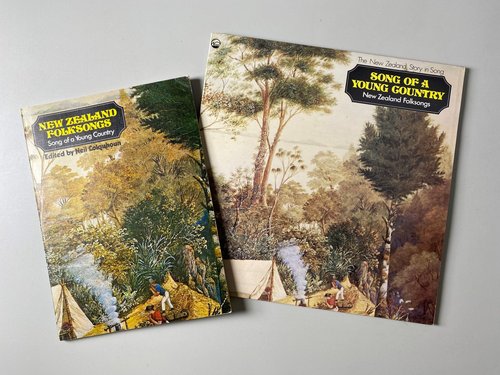
Song of a Young Country (Wellington: A.H. & A.W. Reed, 1972) and Song of a Young Country, Kiwi SLC-101/102 (1971). National Library of New Zealand.
One exciting aspect of the rediscovered 1969 NZBC recording of “Soon May the Wellerman Come” is that it predates Song of a Young Country by over two years, helping document more of the back story of the anthology. “Wellerman” features in the second episode (‘The New Settlers’) of a seven-part radio series with the slightly different title, Songs of a Young Country, written by Colquhoun and broadcast on Sunday mornings in October and November 1969.[iv] The series was itself an expanded version of a concert staged the previous year at the Auckland Town Hall, in which singers presented songs, old and new, linked together with a spoken narrative.[v] Whether “Wellerman” featured at this earlier event is not known. Colquhoun himself sings it for the 1969 NZBC recording.
What else does the recording tell us about “Soon May the Wellerman Come”? Since the mass exposure of the song in 2021, its origins became subject to much scrutiny and debate. The 1969 version puts at least one controversy to rest – and provides another clue about the song’s evolution.
Neil Colquhoun credited his source for “Wellerman” as Frank R. Woods, who apparently learned it from an uncle, and whose great-uncle and father are said to have worked as shore whalers at Wairoa.[vi] Certainly, whaling stations had operated from nearby Waikōkopu and Māhia in the 1830s and 1840s, but did the song really go back that far? After its TikTok fame, commentators pointed out that the chorus melody was strikingly like that of “The Lightning Tree”, written as the theme for 1971 UK children’s television series Follyfoot.[vii] The series had started screening in New Zealand in July 1971, almost a year prior to the Song of a Young Country anthology coming out.[viii] It was also released as a 7” single. This timing begged the question: had Colquhoun ‘borrowed’ the catchy chorus from “The Lightning Tree”? Certainly, he was a folksong populariser, often re-arranging the material he found, adding melodies where needed, and editing lyrics to arrive at accessible versions for contemporary performers.[ix]
The Settlers, “The Lightning Tree” (1971). Theme song for the series Follyfoot (1971-74). YouTube.
Neil Colquhoun’s 1969 “Wellerman” turns out to be very close to the minor-key arrangement printed in the Song of a Young Country (1972) anthology. Given that he was performing it two years before “The Lightning Tree” was written and released, the resemblance can now be confirmed as coincidental.
The 1969 recording of the song also varies in a small but significant way from later versions. Although the episode narration features the word ‘Wellerman’, listen closely and you will hear that Colquhoun sings “Soon may the Weller’s man come” during the chorus. Two years later, this slightly awkward wording had become the more rolling “Soon may the Wellerman come” and it seems likely that Colquhoun made this change. He may have even coined the term ‘Wellerman’. While researching this blog, I’ve been unable to locate any previous use of this word prior to Song of a Young Country, except as a surname.[x]
Further enigmas remain though. The identity of Frank R. Woods is still to be confirmed. One recent account has it that Tommy Wood discovered “Wellerman” as a poem in an old book and, with Colquhoun’s help, turned it into a song.[xi] Others suspect that Colquhoun may have largely written the piece himself. While these matters are yet to be resolved, the 1969 recording adds another piece to the puzzle of this global hit about New Zealand whaling.
“Soon May the Wellerman Come” performed by Tommy Wood, version from Song of a Young Country (1971). YouTube.
For those eager to listen to more Songs of a Young Country, all seven episodes are available in the Ngā Taonga online collection:
Songs of a Young Country - The Early Days
Songs of a Young Country - The New Settlers
Songs of a Young Country - The Far North
Songs of a Young Country - Workin Up Country
Songs of a Young Country - The Gold Fields
Thanks to Matt Sharpe, Daniel White, Beata Nannestad and Apryl Morden at Ngā Taonga Sound & Vision, and John Archer of the New Zealand Folk Song website.
[i] See: https://www.tiktok.com/@nathanevanss/video/6910995345421962498 (accessed 9 July 2025).
[ii] Neil Colquhoun (ed.), Song of a Young Country: New Zealand Folksongs (Wellington: A.H. & A.W. Reed, 1972), p.10.
[iii] Molly Houseman, ‘Wellerman sea shanty a global hit’, Otago Daily Times, 23 January 2021. URL: https://www.odt.co.nz/news/dunedin/wellerman-sea-shanty-global-hit (accessed 27 June 2025); Peter Entwisle, 'Weller, Edward' (1990), Te Ara - the Encyclopedia of New Zealand. URL: https://teara.govt.nz/en/biographies/1w13/weller-edward (accessed 27 June 2025).
[iv] ‘Kiwi Folksong’, New Zealand Listener, 26 September 1969, p.13.
[v] Tania Saas, ‘Song of the Young Country’, Heritage 4 (31 May 1968), p.11.
[vi] Woods is given as the source of the song in the 1972 Song of a Young Country anthology. Additional details were given by Colquhoun in the newsletter of the New Zealand Folklore Society, Penny Post 6/4 (28 January 1972).
[vii] The most extensive discussion appears on the Mudcat Café folk music website, starting with the post at this link: https://mudcat.org/thread.cfm?threadid=13706&messages=146&page=1#4106445 (accessed 28 June 2025).
[viii] See article in The Press (Christchurch), 18 July 1972: https://paperspast.natlib.govt.nz/newspapers/CHP19720718.2.40.4.
[ix] Michael Brown, ‘“The Chantey” and “The Bush Poet”: James Cowan and vernacular song in New Zealand’, Journal of New Zealand Studies 19 (2015), 132-3.
[x] Searches of the National Library of New Zealand’s digitized newspaper, magazine, and book platform, Papers Past, only finds instances of “Wellerman” used as a surname. The term does not feature in Harry Orsman’s Dictionary of New Zealand English (Auckland: Oxford University Press, 1997).
[xi] See Mudat Café post from New Zealand folksinger Mike Harding, who had been corresponding with Tommy Wood: https://mudcat.org/thread.cfm?threadid=13706&messages=146&page=2#4157532 (accessed 1 July 2025).