Northland
The old sounds of the North.
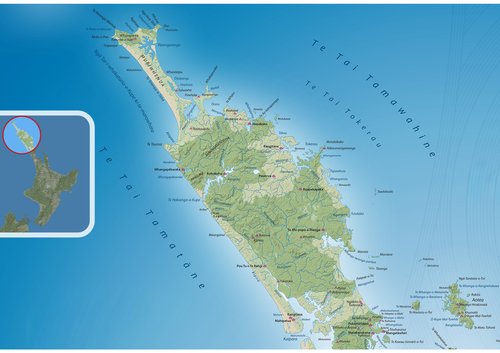
Hero image: Northland, North Island from Te Ika-a-Māui map [screenshot]. Retrieved from the Toitū Te Whenua Land Information New Zealand website, in 2026.
Here, through the voices of kaumātua, listen to the distinctive dialect of Northland.
Preserved in time, histories are recited, landscapes are named, and lineage is captured.
In the north, the use of ‘h' in place of 'wh' is common. These taonga exhibit the depth of the northern dialect where both forms of ‘h’ and ‘wh’ can be heard within a single sentence, where transliterations are commonplace. The glottal stop – a break between the syllables where your throat closes – is strongly articulated in one hapū yet subtly released in a neighbouring hapū.
Through these taonga, the richness and diversity of Northland is heard in the voices of kaumātua who descend from Te Aupōuri, Te Rarawa, Ngāpuhi, Ngāti Hine and Ngāti Kuri.
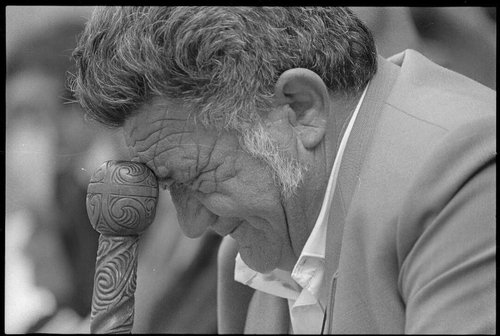
Mr Mac Taylor, Ngapuhi elder, at the Treaty of Waitangi commemoration church service. Dominion Post (Newspaper). Ref: EP/1987/0630/25-F. Alexander Turnbull Library, Wellington, New Zealand. /records/23078290.
Born in Panguru, North Hokianga, William Macdonald (Mac) Taylor is a descendent from Te Rarawa and Ngāpuhi.
Recognised for his extensive portfolio and lifelong commitment to the wellbeing and advancement of Māori communities, Taylor’s reo is a true testament of his lineage.
Listen here to the local dialect, expressions and intonation specific to Northland as spoken by Mac Taylor himself.
Mac starts the interview with Purewa Biddle by first acknowledging the many mountains and marae represented among those listening, and by honouring those who had recently passed.
Mac Taylor speaks of his upbringing.
He remembers being a child, sitting with his elders, as they recited stories and histories of their people, passing down sacred knowledge to the next generation.
Mac discusses the Māoritanga of one’s language and the limits of translating Māori ways of thinking into English.
He believes that the depth and intuition of te reo Māori cannot be understood through the translation of Māori to English alone.
Regional language variations:
Words and phrases unique to this region heard in the excerpts:
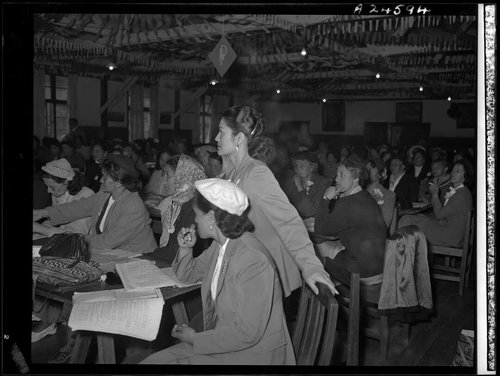
Group at the September 1951 Māori Women's Welfare League conference - Photograph taken by Barry Woods. Tourist and Publicity. Ref: 1/2-040536-F. Alexander Turnbull Library, Wellington, New Zealand. /records/23144576.
Dame Miraka (Mira) Szászy was raised in the remote community of Waihopo.
The first Māori woman to graduate with a degree from the University of Auckland, and a former national president of the Māori Women’s Welfare League, Dame Mira quickly became one of the most influential Māori leaders of the twentieth century and a powerful advocate for wāhine Māori.
Dame Mira discusses the upcoming meeting with the Māori Women’s Welfare League.
She mentions that there are multiple issues for them to discuss – from understanding the origins of these issues to how they will ensure that Māori children, Māori women and Māori more generally will not continue to experience the disparities of the time.
Dame Mira describes the emotional weight many Māori carry when moving to cities and how they no longer turn to their spiritual side for guidance during difficult times.
She also suggests that this burden is closely connected to the impacts of colonisation.
Herewini Murupaenga asks which of the elderly women and men helped guide and teach Dame Mira as she moved through the world.
Words and phrases unique to this region heard in the excerpts:
Collection Reference: TZP43038. Year: 1985. Credit: TVNZ.
Eparaima Te Paa, also known as Ephraim Te Paa, was a respected kaumātua of Te Rarawa.
He was praised for his oratory skills and held great knowledge from the old school – the place of higher learning.
Listen as Eparaima offers a prayer, drawing the audience into the presence of the spiritual realm.
There was once a chief named Ueoneone, who lived in the shadow of Hikurangi, the great mountain of the Far North – not to be mistaken with that of the East Coast.
Eparaima speaks of the moment in every life when the heart turns outwards, seeking someone to hold and love.
This is the story of Ueoneone and Reitu.
The tekoteko (carved figure) of Te Ohaki meeting house depicts Ueoneone and Reitu bound together as one, a rare and powerful testament of their love, for a woman had never been carved at such great height.
This tekoteko is the embodiment of their union.
Words and phrases unique to this region heard in the excerpts: