Early tourism promoters used the new technology of filmmaking to show the country’s natural beauty and unique culture to potential visitors. Here are just a few examples.
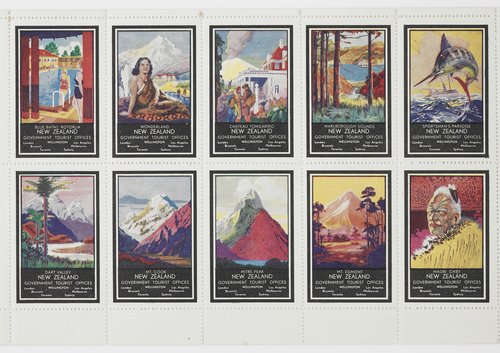
Hero image: Sheet of cinderellas, Department of Tourist and Health Resorts, 1937. Te Papa, reference number PH001236.
This year our national heritage organisations are commemorating an impressive milestone; 125 years of tourism in Aotearoa New Zealand. Although people certainly visited for sightseeing and leisure before that, it was in 1901 that that the Department of Tourist and Health Resorts was created. It was the first government agency of its kind in the world, responsible for promoting and controlling important tourist sites, and providing information and other services to travellers. Its Wellington office even offered a darkroom for travelling photographers. As an editorial in the New Zealand Times of 30 October 1901 explained:
“The gardens, parks, springs, baths, geysers, sanatoriums, dwellings, etc., at Rotorua, Whakarewarewa, Waiotapu, Te Puia, Nuhaka, Waikaremoana, Hanmer, Mount Cook, and dozens of other places which could be mentioned, are now under the administration of the Tourist and Health Department, which is responsible for their upkeep, utilisation and development.”
Alongside postcards, guidebooks and posters, early tourism promoters used the new technology of filmmaking to show the country’s natural beauty and unique culture to potential visitors. New Zealand’s film industry grew up alongside its tourism industry, with the Government Publicity Office, Filmcraft, and the National Film Unit among the several production houses that made compelling and patriotic tourism movies. Some of these were shown within New Zealand as newsreels or featurettes before movies, while others were intended for distribution abroad. Below are just a few highlights from the Ngā Taonga collection – many more early tourism films can be found via our search page.
Note: Given their age, some of these films contain outdated language, colonial attitudes, sexism, and/or inaccurate information about te ao Māori. The footage and commentary within the films reflects the time in which it was taken.
Where the Blue Pacific Rolls (1926)
A pre-sound film by the New Zealand Government Publicity Office that takes viewers to Northland. The title cards wax poetic about the fertile lands and rugged coastlines of the winterless North, but the real star is the Pacific Ocean in its many moods. Whenever we do see shots of the land, it’s clear how much has changed in 100 years; there are no cars or even sealed roads to be seen along the shore, with fishing, horseback riding and boating the only human activities in evidence.
Deep Waters (1926)
In 1926 the American novelist Zane Grey visited Aotearoa New Zealand on a fishing and hunting tour. Grey was a major celebrity, so the Government Publicity Office took full advantage of his trip. Deep Waters: Swordfishing in New Zealand was made to attract tourists wishing to follow in Grey's footsteps.
Tongariro. New Zealand’s Winter Playground (1927)
This charming silent film was described as follows after a preview screening at Wanganui on 27 September, 1926 (thanks to Clive Sowry for the research):
"Other scenes in this excellent film showed members of the party snow-balling each other while a snow-storm was in progress and a young lady "artiste" modelling a man out of snow. . . . An impromptu jazz-band in action caused a gale of laughter. Each member of the party played an "instrument." Anything from tissue-paper and combs to radio loud-speakers were used and judging from the moving-record, the camp cook must have missed most of his culinary utensils that day. Fortunately, the movie camera did not record the noise produced by the weird combination!”
Sunny Napier – the Brighton of New Zealand (1929)
Part of the Know New Zealand First series of films by the New Zealand Government Publicity Office. Poignantly, while this film was simply intended to attract visitors to the town, just two years later the Hawkes Bay Earthquake would completely change Napier, making Sunny Napier – the Brighton of New Zealand a valuable record of the buildings and streets that were lost.
Romantic New Zealand: Land of the Long White Cloud (1934)
Part of the Romantic New Zealand series, this feature length (for the time) film presents a very colonial view of New Zealand’s history. The historical reenactments of British settlers ‘civilising’ the country are uncomfortable viewing 90 years later but probably reflect what was taught in schools in the 1930s. The film then takes the viewer on a whirlwind tour of major cities and tourist sites. Land of the Long White Cloud includes footage of the famous Guide Rangi (Rangitīaria Dennan, Ngāti Tarāwhai) of Rotorua.
Weekend in New Zealand (1955)
Neuline Studios, headed by Robert Steele, were prolific makers of industrial and promotional films in the mid-20th century. Along with views of Auckland, Tongariro, Rotorua, Queenstown, the Southern Alps and much more, Weekend in New Zealand also provides a detailed look at what it was like to travel on Tasman Empire Airways Ltd (TEAL) in the 1950s, when flying to and from Australia was a luxury. Selwyn Toogood narrates.
Pounamu – Guide Rangi (1990)
As the 20th century progressed, New Zealand gradually developed a more confident and independent national identity. Filmmakers moved on from presenting it as a White Man’s Paradise, a miniature England, or an untouched wilderness for hunting, fishing and sports. Māori culture, language and history became understood as a unique selling point that no other country could offer and Māori tourism providers gained in respect and prominence. Among the most famous was Rangitīaria Dennan, known as Guide Rangi, whose extraordinary career as a tour guide to the stars is traced in this Pounamu episode.
This is New Zealand (1970)
No discussion of tourism movies would be complete without mentioning This is New Zealand.This is New Zealand is a very unusual three-channel colour film made for Expo ’70 in Osaka, Japan, and is described in the Unesco Memory of the World Register as “one of the National Film Unit’s crowning achievements”. Ngā Taonga and our colleagues at Archives New Zealand both hold copies that we are responsible for caring for, and a digitised version can be viewed on the Archives NZ website.
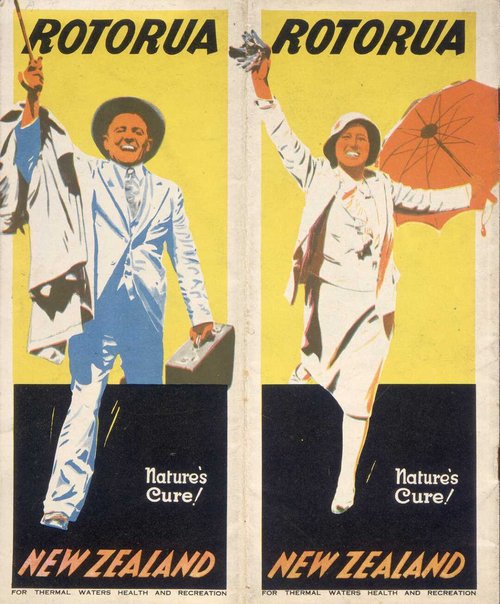
Alexander Turnbull Library Eph-A-TOURISM-Rotorua-1930s-02-back
New Zealand Railways. Publicity Branch: Rotorua, New Zealand. Nature's cure, for thermal waters health and recreation. [1930s]