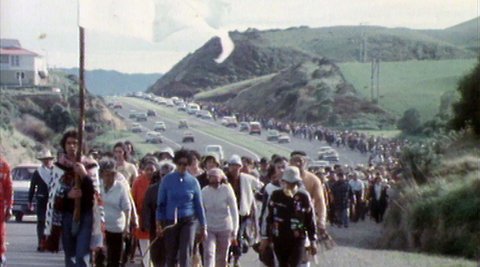
Background to the making of Te Matakite o Aotearoa: The Māori Land March
11 Sep 2025
Director Geoff Steven reflects on the making of the landmark documentary.
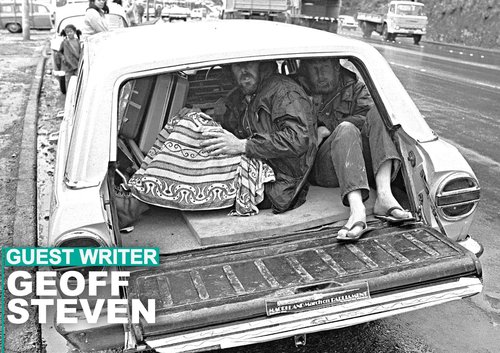
Hero image: Geoff Steven (right) and Leon Narbey (left) in the back of a Holden in Wellington on the final day of the Māori Land March. Credit: John M Miller – Photographer.
By Geoff Steven, Director / Editor
The mid-1970s were exciting and changing times. We had recovered from the culturally turbulent 60s and we baby boomers were flexing our own muscles both culturally and politically. As the Dylan song said, “… the times they are a changing…”
I was a young filmmaker and heading up a filmmaker’s co-operative, Alternative Cinema. We had shared editing equipment, published a monthly magazine which advocated for a local film industry as well as featuring articles on film language and reviews etc., and organised screening of films that didn’t have main cinema release. Personally, I was interested in the so called ‘direct cinema’ or cinema verité style of documentary making where practitioners documented what happened in front of their camera and didn’t go into projects with set objectives; rather just letting the story unfold in front of the lens ‘as it happened’. I was initially a cameraman, not a journalist, so the visual and ‘actuality’ side of a story was what mainly motivated me.
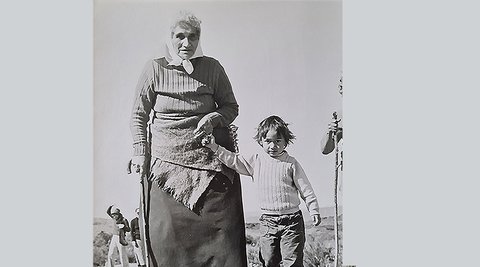
Being around the edge of the political scene that was active in Auckland at that time, I learned of the plans of a group of Northern Māori to undertake a protest march from Te Hapua in the far north to Parliament in Wellington to protest the alienation of Māori land. It was to be led by a matriarch and female leader of Ngāpuhi, Dame Whina Cooper.
This seemed to me an ideal opportunity for me to have a shot at making an observational type of documentary and at the same time help spread the message of the march to a wide audience. The participants on the march would tell the story of its aims and message. I didn’t want to use any explanatory voice over which was the standard style of documentary at that time. There would be no journalist standing talking to the camera explaining what they thought was important and describing what was happening behind them!
I met with Whina and some of the march organisers and, at a number of meetings, explained my aims and filmmaking philosophy. It was basically to capture what happens when it happens and attempt to portray the spirit and atmosphere of the undertaking and by documenting that, explain its underlying reasoning and political message.
Eventually, I was given permission for me and my crew (as yet to be found) to travel with the marchers as part of the core group. There were to be no other film people allowed to travel the whole distance or to be given such close and intimate access.
The next challenge was to raise the money to make the film as it had to be well beyond the short, hand to mouth productions I had previously been involved in. I approached the newly established TV2 Network and eventually they agreed to help support the documentary in return for NZ screening rights. It was to be the first ever New Zealand documentary to be shown on TV2.
The arrangement with TV2 was that they would supply the camera equipment and film and processing, but more importantly, they would allow a good friend of mine and a great cameraman, Leon Narbey to travel with us for the whole march and be the main cinematographer. At that time, Leon was then a staff cameraman at the TV2 Christchurch offices. I would shoot second camera as well as direct.
Phil Dadson was another friend and member of the Auckland co-op, and he became the documentary sound recorder. Phil and I had formed a production company, Seehear Films Ltd, and that became the entity we made the production under.
The final member of our small team was an Australian filmmaker who had travelled on the protest boat “Fri” to Mururoa when it sailed to confront the French over the Pacific H Bomb tests. He was to be the camera assistant and general assistant on the road. For four Pākehā lads, it was to be a fascinating experience.
With the crew in place, we still had to fund the daily shooting expenses and the numerous post-production charges which had to be covered when making a documentary that was contracted to be delivered for screening on prime-time TV. I didn’t want to be associated with an unfinished programme.
Using contacts in some of the numerous political groups that were active at the time, we managed to scrape together enough funding to cover the basic budget we had allocated. Anti-racism church groups and the Polynesian Panther Party and Ngā Tamatoa all helped get the film off the ground.
The great fear making a documentary on an open-ended event such as a protest march that was planned to take at least a month to complete, was that we didn’t have any idea of what we would be able to film and what was going to be important or not. We had limited film stock and not the freedom of today’s “when in doubt, shoot it” digital recording environment.
Also, there was the background fear of what would be interesting and relevant to film. Would we get footage that would make a good documentary suitable for a general TV audience? We also didn’t know what might happen when we all hit the road. Would anyone actually come and join the march? Would it even reach its destination as sore feet, and the endless miles took their toll?
We (and I think some of the key organisers) had no idea of the importance and impact it would have as it slowly wound down the country. I didn’t intend to use any narration to tell the audience what they were seeing but wanted instead to rely on what actually happened in front of the camera. It is a risky style for covering an open-ended event.
[NB: it is interesting to note in hindsight that the completed hour-long film was made on a ratio of just 4:1. That is, we only shot just over 4 hours of total film time on an event that took so many weeks to unfold!]
But after buying a second-hand Holden station wagon to use as a crew car and packing our few bags of gear, the four of us turned up in Te Hapua to start on our long journey south. We were to spend the next month eating and sleeping on marae down the length of the North Island and spending time with some remarkable and dedicated people, sharing their passion, humour and the kaupapa of the march.
It was a remarkable journey, both personally and professionally and it would eventually lead to a finished documentary, Te Matakite O Aotearoa.
The few interviews that we undertook were made ‘on the run’ and I just asked questions which interested me and therefore hoped might give some context and background for the eventual television viewing audience. Keeping with my commitment to a ‘direct cinema’ style of filmmaking, in the edit we left my questions in as I was heard learning about the kaupapa of the march at the same time as the viewers did. I wanted to keep the feeling of things unfolding in front of us as we travelled down the country, not knowing what would happen next.
The finished film is the story of a group of people, who with dedication, determination and dignity took their message to the country; a group of people who marched into our collective history. We as filmmakers tried to do our bit also as we worked to capture some of the spirit of the event as well as its important message...
Now, 50 years later, the documentary hopefully gives contemporary viewers a rewarding glimpse of the people and passion behind that historic event.
11 September 2025
11 September 2025