How news of Takrouna, and Sgt. Haane Manahi, made it home
22 Apr 2026
Sound history researcher Sarah Johnston takes a look at how the NZ Broadcasting Unit reported an extraordinary war story.
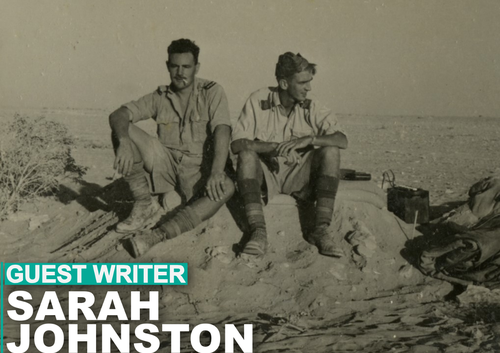
In April 1943 in the midst of World War II, the New Zealand Division was in North Africa, fighting its way across German – and Italian – occupied Tunisia. Radio correspondent Arch Curry and engineer Norman 'Johnny' Johnston of the New Zealand Broadcasting Unit (NZBU) had been travelling with the 'Div' since October the previous year, covering months of hard desert fighting through Egypt and Libya.
They had covered pivotal moments such as the Second Battle of El Alamein in late October 1942. Arch Curry's reporting on the start of this action had been a scoop, broadcast worldwide on shortwave radio via the BBC Overseas Service. The NZBU men had come under enemy fire on several occasions and were travelling and living alongside the New Zealand troops, enduring the same hardships of life in the desert where water was always in short supply.
"I haven't washed any part of me except my face and hands for the past three weeks", 25-year-old Johnston cheerfully wrote to his parents in November 1942, "but I'm not lousy yet! My hair is at least a foot long but by sprinkling water on it each morning it forms into a cake of mud and stays in place for an hour or so." (1)
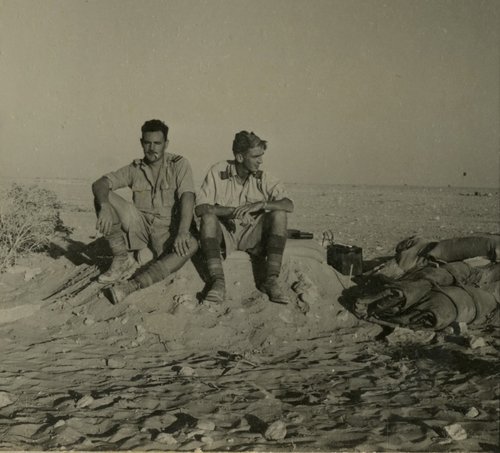
NZBU engineer Johnny Johnston (right) and an unknown man in the North African desert c. 1942. Johnston family collection.
Johnny's colleague was seasoned Christchurch radio announcer Arch Curry. Curry wrote voice reports on New Zealand military action which were recorded by Johnston onto 12-inch lacquer discs using a portable Presto recorder. This equipment was travelling with them and their supplies in an army-issue truck, allocated to the NZBU by the military authorities together with an army driver. In April 1943 their driver was Donald 'Chris' Ruhi, a young Te Arawa man from the 28th Māori Battalion. Men from the Battalion's B Company were about to feature in an episode of exceptional fighting, which would be reported on by Curry.
Once recorded onto discs, Arch's voice reports, or 'despatches' as they were called, were sent by the fastest means possible, back across the desert to the NZBU base at New Zealand's Maadi Camp outside Cairo. Many, such as the El Alamein scoop, were sent via an army motorcycle despatch rider, but occasionally they were able to get discs onto an Allied plane headed back to Cairo. Once Arch's report was cleared by military censors, it was played over radio links to the BBC in London, who would record it there and then broadcast it out to the world via their Overseas Service. Today this seems a laborious process, but in 1943 it was a new immediacy in broadcast news coverage, and it meant within days New Zealand radio listeners could hear about the actions of their men on the far side of the world, reported by a New Zealander who was actually with them.
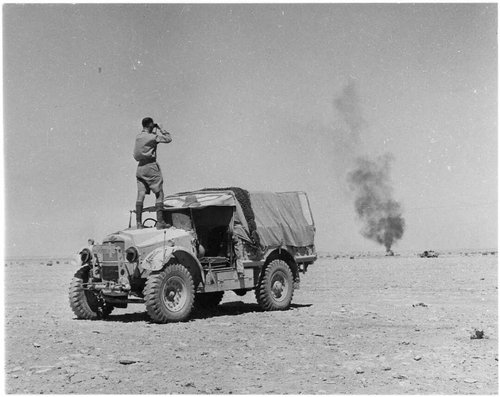
NZBU correspondent Arch Curry standing on an army truck watching a burning vehicle at El Alamein, Egypt. Photograph taken by H. Paton, c. 9 July 1942. Ref: DA-06752-F. Alexander Turnbull Library, Wellington, New Zealand.
In April 1943, two of Arch Curry's despatches reported on fighting around the Tunisian town of Enfidaville and the marathon effort by men of the Māori Battalion to capture a rocky desert outcrop and village called Takrouna. Its sheer rock sides were topped by an old Berber fort, occupied by several hundred Italian and German troops who had a prime vantage point from which to fire on the New Zealand troops on the desert floor below.
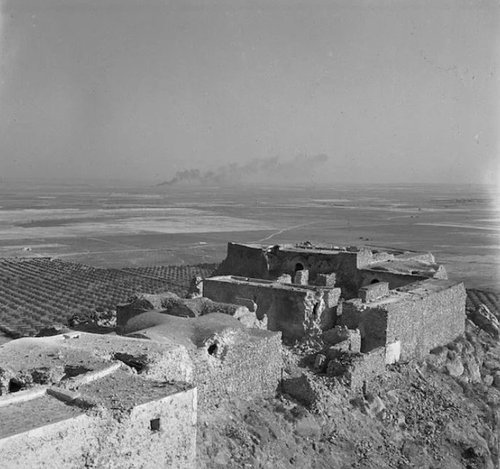
General view from Takrouna. Photograph by M.D. Elias, 1 June 1943. Ref. DA-02251-F. Alexander Turnbull Library, Wellington, New Zealand.
"All eyes are on Takrouna ... where one of the most dramatic episodes of the Middle East campaign is being enacted," Arch's first report begins, recorded on 21 April 1943. "Further advance and consolidation may be held up until the enemy is shaken from the top. Well, the process of shaking him out has been given a good start by a remarkable action carried out by a handful of Māoris. At first light after the main night attack, just when a light mist was melting away around formidable-looking Takrouna, five Māoris, one of them a sergeant, set out to do the impossible."
(In his reporting Arch used the plural "Māoris", which was common in the 1940s, but is now considered grammatically incorrect).
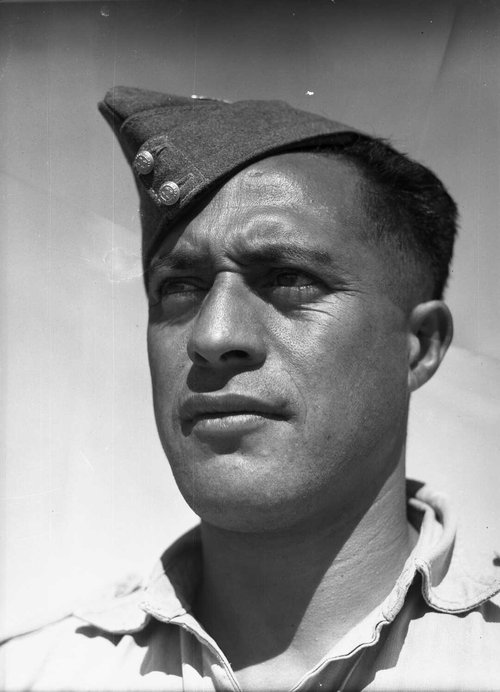
Sergeant Haane Manahi (Te Arawa, Ngāti Raukawa) Photograph taken by George Bull, Maadi, Egypt, c. 10 June 1943 Ref: DA-04139. Alexander Turnbull Library, Wellington, New Zealand.
The sergeant was Haane Te Rauawa Manahi (Te Arawa and Ngāti Raukawa), and for his exploits at Takrouna he was recommended for a Victoria Cross by six high-ranking officers, including General Bernard Montgomery, commander of the British Eighth Army. However, for unclear reasons, this was later downgraded to a Distinguished Conduct Medal. The feats of his small unit and the subsequent V.C. downgrade controversy are the subject of Sgt. Haane, a new film by director Tearepa Kahi, opening in New Zealand cinemas on April 23, 2026.
Arch Curry's 1943 Takrouna reports can be heard online. They are full of praise for the actions of Manahi and the men who accompanied him:
"Takrouna could not be scaled, it was said ... but these men were Māoris and so, it was otherwise. On their own initiative, they began a most daring hand-over-hand ascent under fire ... with tommy guns fastened to their backs."
After scaling the 600-foot cliff carrying their weapons, Manahi's party of 12 engaged with the enemy and forced the surrender of nearly 100 Italian troops.
"A daring act by a few lightly armed men has played a vital part in a major operation. Their story rises clear above the heavier news of shells and metal, as a tale of personal skill and initiative, which has always been a characteristic of the Māori soldier," Curry concluded.
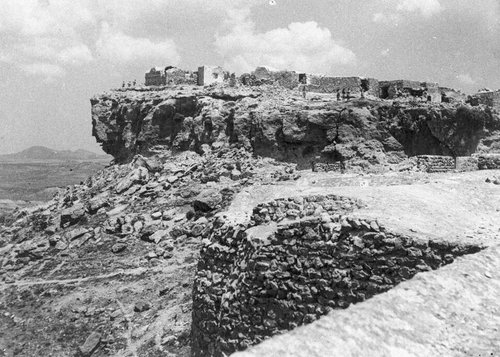
View of Takrouna Heights, Tunisia taken by J.C. Pattle, May 1943. Ref: DA-10929-F. Alexander Turnbull Library, Wellington, New Zealand.
The following day he was able to record another report on how further fighting on top of Takrouna had unfolded over the next 24 hours. The enemy was able to retake the Berber fort, with reinforcements appearing via a previously unknown tunnel and trapdoor hidden under one of the buildings. But further fighting, again led by Sgt Manahi, eventually forced a final surrender of some 300 German and Italians.
The first New Zealand newspaper coverage of the heroic action at Takrouna appears over a week after the assault, on the 29th and 30th of April, in articles like the one below from The Christchurch Press. It would be nice to think Arch Curry and the NZBU had scored another world scoop with his reports, recorded over a week earlier on the 21st and 22nd. However, it is unclear when Curry's Takrouna reports actually made it to the BBC, or exactly when they were heard in Aotearoa.
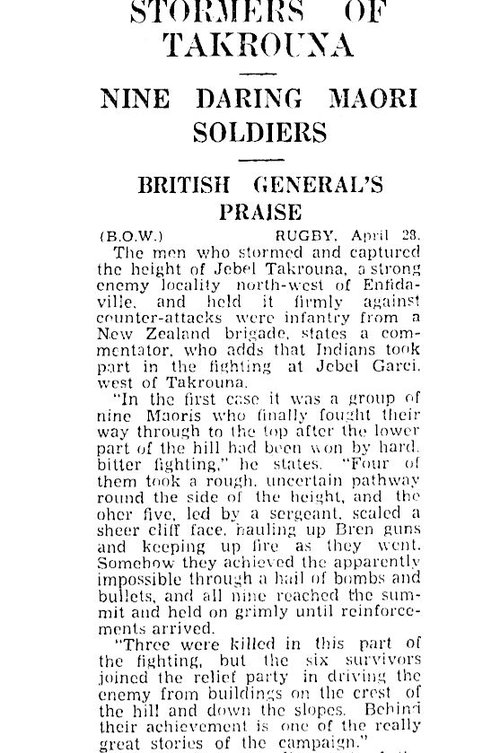
The Christchurch Press, 30 April 1943, p.5. Via Papers Past.
In early 1943 the previously well-established path for clearing news reports via the British military censors in Cairo had changed with the arrival of American troops in North Africa and the establishment of Allied Force Headquarters in Algiers. Now Arch Curry's reports had to be cleared there by American censors, with whom the NZBU had no prior relationship. Previously, if censors found problems with a report, the NZBU base at Maadi was able to edit recordings and re-send them, but they had no such facility in Algiers. Also, it was found the radio links between Algiers and London were poor, with voice reports sometimes unintelligible when received in London. (2)
Johnny Johnston ranted about the problems getting their output on air in a letter in early April 1943:
"Since this action started Arch has sent four darned good despatches to the American censors in Algiers (they now handle all our stuff) but up to the present not a sign of any of them has come back from the BBC ... as we know from past experience how keen the BBC are to get NZ news, we can only assume that the bloody, worthless Yanks have stopped the lot. This is borne out by the fact that even the BBC men's own stories on the NZ actions which we know have been sent, have not been broadcast either. Unlike the excellent censors in Cairo, these new and nervous ninnies apparently object violently to accounts of battles which are in any way detailed." (3)
By 1943, BBC shortwave news bulletins were being recorded and re-broadcast eight times a day by New Zealand Broadcasting Service (NZBS) stations, so there was plenty of opportunity for New Zealand to hear Curry's reports – if the BBC had received them. The only evidence I have found of Arch Curry's reports from Takrouna being heard on air here is an archived recording of a BBC news bulletin, held at Ngā Taonga Sound & Vision in the RNZ Sound Archives. For 24 hours a day a 'listening watch' was maintained at station 2YA Wellington and a staff member would spring into action and record any momentous war news they heard, as well as regular bulletins of war news. These could then be replayed on NZBS domestic broadcasts.
On 29 April 1943, the listening watch recorded a BBC news bulletin which included a "despatch from Tunisia." On listening to this 83-year-old shortwave recording, I recognised several phrases. The despatch was Arch Curry's Takrouna report from 21 April. However, it was not Arch's voice. His report had been abridged and re-voiced by a BBC announcer in London. Presumably the troublesome American censors in Algiers had eventually passed it, but perhaps the audio quality as it was received in London was not good enough to play on air, so a BBC announcer re-voiced his report for broadcast. This delay meant it went to air at the same time as the newspaper reports on Takrouna were being printed. So, no scoop for the NZBU this time, but at least their reporting of the Māori Battalion at Takrouna made it to home airwaves in some form.
The NZBU prided themselves on being as close to the action as possible, travelling alongside the men they were recording and reporting on, unlike some press correspondents who they felt remained in more comfortable conditions well back from the action. Johnston concluded in his letter:
"At Tebaga [a scene of fierce fighting in March 1943] we were the only correspondents actually up with the show and had a clear beat of 36 or more hours on a really big story, over the teeming hordes who inhabit the rear areas, and up to the moment [we] have not a darned thing to show for it. No doubt the stuff will eventually come to light, but by the time it does it will be as dead as forty doornails ... This episode illustrates most strikingly what a discouraging and often futile game news gathering in war time can be." (4)
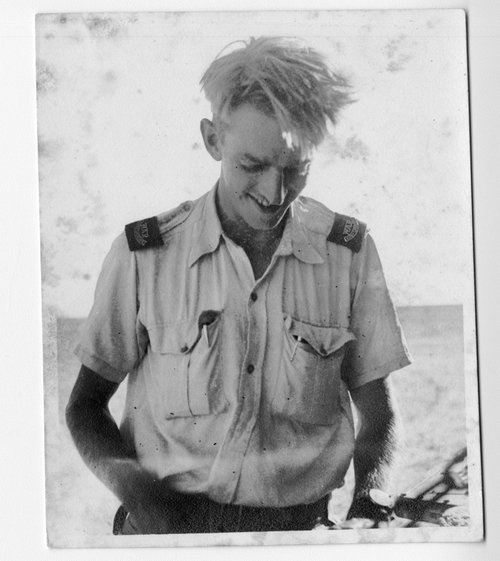
NZBU engineer Norman 'Johnny' Johnston in North Africa c. 1942. Johnston family collection.
Two weeks after the action at Takrouna, fighting in North Africa came to an end with the surrender of the German and Italian Axis forces on the 13th of May. The NZBU returned to the rocky fortification to see it up close for themselves, as Johnston described in another letter home.
“We spent all day on the 13th pottering about Takrouna and other enemy positions, while streams of prisoners came pouring out of every defendable ridge carrying their wounded. Had it not been for the splendid action of the Māoris, Takrouna would have been the most depressing place imaginable... We reached the top by means of a scaling ladder but the Māoris didn’t even have that and how they managed to get up under heavy fire I can’t imagine. They certainly deserve to get a high decoration for the job. Ngarimu’s V.C. has made them about the proudest battalion in the Div and if they get another, they’ll be right on top of the world.” (5) (6)
From those comments, it seems the New Zealand broadcasters had heard about Sgt. Manahi being recommended for a Victoria Cross. New Zealand Prime Minister Peter Fraser also believed the Māori Battalion action at Takrouna was worthy of the highest recognition, as you can hear in this recording of him speaking in Auckland on 21 June 1943. However, it was not to be and in July, Sergeant Manahi was awarded the Distinguished Conduct Medal instead.
New Zealand's 5th Brigade suffered over 500 casualties taking Takrouna – many as a result of the heavily mined land around the rocky outcrop. Forty-six men were killed. The Māori Battalion lost almost all its officers who were either killed or wounded in the fighting, 124 casualties in total. To read a detailed account of the Battalion action at Takrouna, visit the 28 Māori Battalion website. Moe mai rā e ngā toa.